How to Calculate Your Net Worth (Worked Example + What to Count)
One number that shows whether you're actually getting richer, with a worked example.
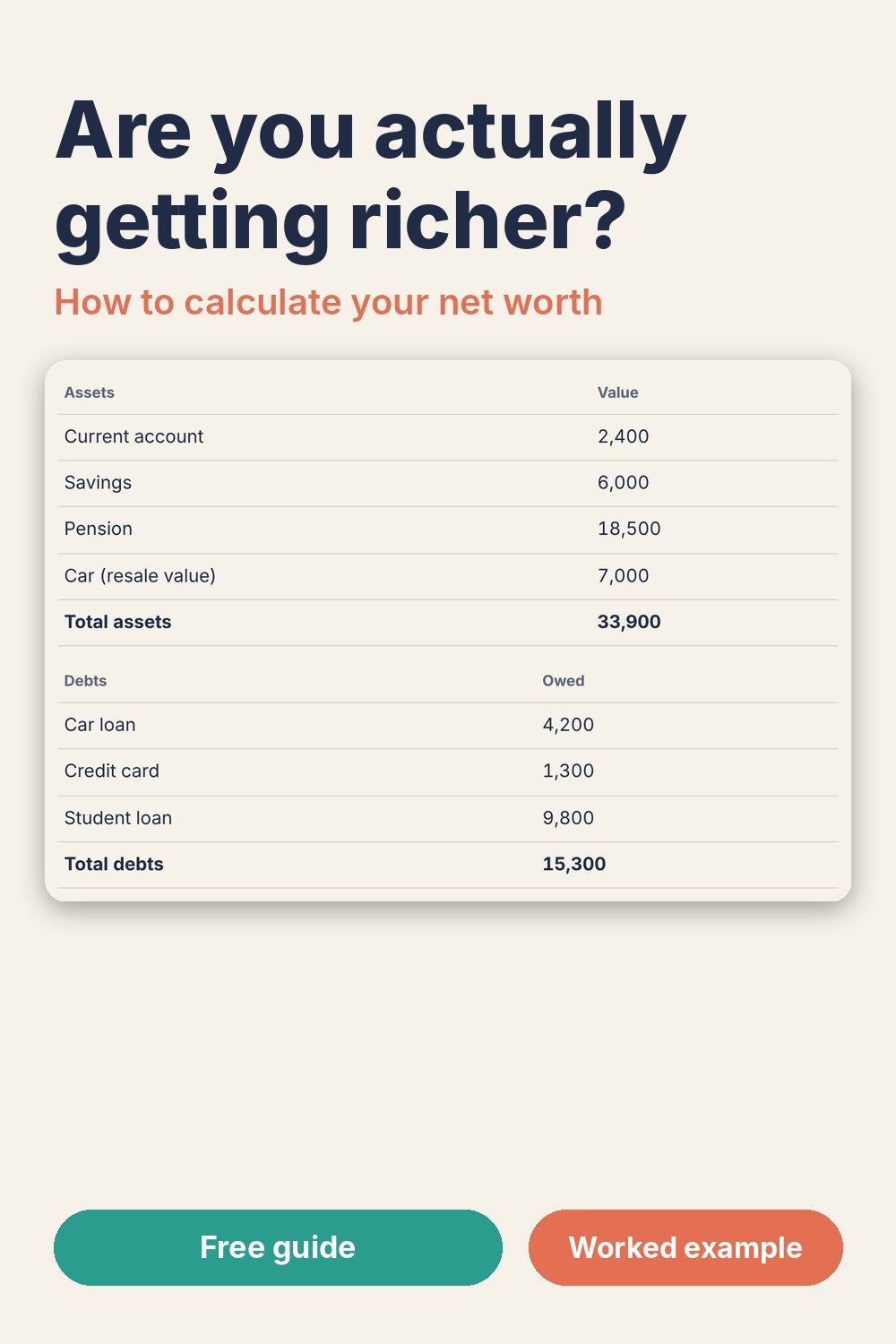
Net worth is everything you own minus everything you owe. One number, and the trend over time tells you more about your finances than any single month's budget.
Worked example
| Assets | Value |
|---|---|
| Current account | 2,400 |
| Savings | 6,000 |
| Pension | 18,500 |
| Car (resale value) | 7,000 |
| Total assets | 33,900 |
| Debts | Owed |
|---|---|
| Car loan | 4,200 |
| Credit card | 1,300 |
| Student loan | 9,800 |
| Total debts | 15,300 |
Net worth = 33,900 − 15,300 = 18,600. Debt-to-asset ratio: 15,300 ÷ 33,900 = 45%.
What to count (and what to leave out)
- Count: cash, savings, investments, pensions, your home and car at a realistic resale value.
- Leave out: furniture, clothes and gadgets. They're hard to value and rarely sell for much.
- Debts: mortgage, loans, credit cards, anything you owe, at today's balance.
Track it monthly, not daily
Update the numbers once a month, on the same day. The change versus last month is the number to watch: paying down debt and saving both push it up. A negative net worth is common early on, especially with student loans; the direction matters more than the starting point.
Spreadsheet version
The net worth tracker spreadsheet takes up to 20 assets and 15 debts, keeps monthly snapshots with the change versus last month, and shows your debt-to-asset ratio, average monthly change and a trend chart for the year.

Get the Net Worth Tracker on Etsy
Paying off more than one debt? Try the free debt snowball vs avalanche calculator.
Get the 2027 money sheet deals by email
We'll tell you when our budget, debt and savings spreadsheets are on sale (up to 30% off from 27 November), plus one money tip now and then. Unsubscribe anytime.
Questions
How do you calculate net worth?
Add up the value of everything you own, then subtract everything you owe. In the example, 33,900 − 15,300 = 18,600.
Should I include my house and car?
Yes, at a realistic resale value, and include the mortgage or car loan as a debt.
Is a negative net worth bad?
It is common early on, especially with student loans. What matters is that it rises month by month.
Updated 22 November 2026. A planning guide, not financial or tax advice.